
Page County Projected Release Meaning
A projected release date is an estimate based on the sentence and facts known to the agency at the time. An actual release date records the completed event. The two should not be used as if they were the same. Credits may change. A new court order may arrive. Another agency may lodge a detainer, which is a request to hold the person for that agency. A transfer can also end one facility’s custody without returning the person to the community.
Page County pretrial detainees have no sentence-based completion date. Bond, recognizance, dismissal, a later hearing, or another hold can affect when they leave. A sentenced Page County inmate may have a jail computation. A VADOC prisoner has a state computation based on the governing sentence regime. First determine which group applies. Page County’s extensive use of contract beds also means the court county and physical jail may differ.
The release record should identify the time, disposition, facility, and any receiving agency. A court order explains the legal basis, but it may not show when processing finished. The broad Page County released inmate search explains how those records and custody systems fit together.
Find Page County Projected Release Dates
Start with custody type and last confirmed facility. For a Page County Jail or contract-jail sentence, ask the physical custodian for the current computation and ask the Page County court clerk for the sentencing order. For a VADOC sentence, use the Inmate and Supervisee Locator, then consult VADOC Time Computation. The public locator landing page does not document a result label literally called “Projected Release Date” or “Tentative Release Date.” Do not invent one. Read the exact live label on the matched record.
The VADOC locator accepts the first three letters of the first name and the full last name, or a seven-digit DOC ID. Optional filters include location, race, gender, and age range. It includes current VADOC custody and active probation or parole supervision. A Page resident who completed a local misdemeanor may never have a VADOC record. Someone fully discharged from all VADOC custody and supervision may no longer appear because the locator is not promised as a permanent historical archive.
- Identify Page Jail, the actual contract jail, or VADOC as the current authority.
- Obtain the sentencing order and note offense dates, active terms, and whether sentences run together or one after another.
- For VADOC, search by DOC ID or the required name fields and read the exact live date wording.
- For local time, ask the jail for its current computation and recorded credits.
- Ask about detainers, later orders, discipline, or transfers that could change the estimate.
- After the date passes, obtain the actual release entry and any signed release paperwork.
Record the date of the search. VADOC says its public locator is updated daily but may contain inaccurate or outdated information. A saved result shows what the system reported, not a certified final calculation.
Page County VADOC Release Computation
Virginia divides sentence calculations by offense date and legal regime. Under the older Good Conduct Allowance system, generally used for felony offenses before January 1, 1995 and misdemeanors before July 1, 2008, VADOC calculates parole eligibility, mandatory parole release, and good-time release for qualifying active sentences over 12 months. Credit classes can range from no credit to 30 days for each 30 days served.
For felony offenses on or after January 1, 1995, Earned Sentence Credits generally replace discretionary parole. Virginia Code §53.1-202.2 defines one earned credit as one day deducted from the term. Section 53.1-202.3 sets offense categories and rates. ESC-1 categories may earn up to 4.5 days per 30 days served, while eligible ESC-2 offenses may earn up to 15 days per 30. Section 53.1-202.4 governs classification, earning, and forfeiture rules.
The official VADOC Time Computation page explains the agency framework:
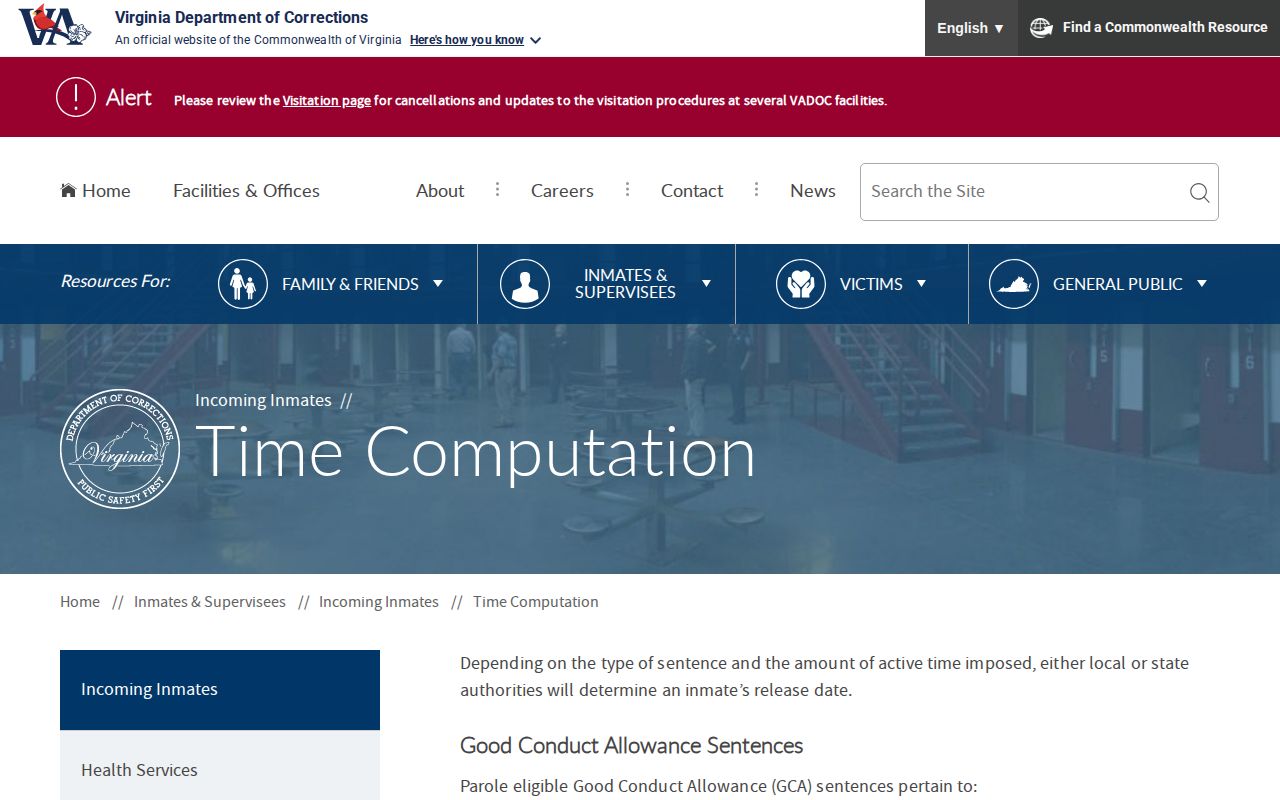
The source helps identify which rule set may apply. It does not provide enough facts to calculate one person’s Page County release date without the complete sentence record. Forfeiture also matters. Virginia Code §53.1-189 permits loss and limited restoration of specified credits. The active term, all sentences, prior jail credit, and current earning class must be reconciled by the responsible agency.
Page County Release Credit Rules
Virginia’s familiar “85 percent” phrase is a general description, not a promise for every Page County case. VADOC states that discretionary parole was abolished for post-1994 felonies and that prisoners generally must serve at least 85 percent when the maximum 4.5-per-30 ESC-1 rate applies. The legal structure includes §53.1-165.1 and the earned-credit provisions.
Several cases fall outside a simple 85-percent statement. ESC-2 eligible offenses can use a different credit rate. Older sentences can fall under Good Conduct Allowance rules. Misdemeanors, mandatory minimums, and special parole-eligibility groups also differ. A mandatory minimum generally cannot be shortened through ordinary good-time assumptions. Consecutive sentences are served one after another, while concurrent sentences overlap as directed by the court.
- Earned sentence credit
- A statutory day deducted from an eligible active term.
- Mandatory minimum
- A required term that ordinary credits may not reduce.
- Concurrent
- Terms served at the same time as ordered.
- Consecutive
- Terms served one after another.
- Detainer
- A request from another authority to hold or transfer a person.
No public calculator can safely replace the official Page County computation. The offense date, statute, each order, present credit class, and any forfeiture all matter. Use the result as orientation, then ask VADOC or the jail for the agency’s current figure.
Page County Jail Release Credits
Local jail rules differ from the state-prison framework. Virginia Code §53.1-116 addresses credits for local prisoners. A sentenced misdemeanant with no more than 12 months can earn one day for each day served when there are no rule violations, unless a mandatory minimum applies. Parole-eligible prisoners can receive 15 days per 30 satisfactory days. A jailer may also award five more days per 30 for qualifying work or classes when such opportunities are offered.
Post-1995 felony credits in a jail remain limited by the earned-credit article. Jail staff cannot disregard the governing sentence or invent a different credit class. The Page County court order, prior confinement credit, and the jail’s calculation must agree. If the person is held at a regional jail under contract, identify which agency maintains the computation and release entry.
Page County Jail also offers work release and narrowly described home electronic monitoring. These permit approved activity or monitored community presence while custody or sentence conditions continue. Neither is the same as full discharge. A projected end date must account for the ongoing legal status and any later court action.
Note: Ask the actual custodian for the computation; Page County charges do not prove that the person is physically housed at Page County Jail.
Why Page County Release Dates Change
A Page County release estimate can move for legal, disciplinary, and administrative reasons. Some factors reduce a term. Others delay the end or change the destination. A transfer may occur on the forecast date yet leave the person in another agency’s custody. The table separates common causes without predicting their effect in a specific case.
| Factor | Possible effect | Best confirmation |
|---|---|---|
| Earned or good-time credits | May reduce an eligible active term under the governing rate. | Jail or VADOC computation. |
| Discipline or forfeiture | May remove credits and move the estimate later. | Agency computation and lawful records. |
| Concurrent or consecutive orders | Changes whether terms overlap or follow each other. | Final court orders. |
| Detainer or other hold | May cause transfer instead of community release. | Custody record and receiving agency. |
| Parole decision | May authorize conditional release for an eligible sentence. | Board decision plus VADOC release record. |
| New or corrected order | Can alter the term or credit recognized by the agency. | Court file and updated computation. |
Parole eligibility exists only for categories preserved by Virginia law. A monthly Board decision can precede actual processing and may not resolve another hold. It should not be treated as the exit time. Likewise, probation after active time can place someone in the community while conditions remain. A supervision location is not the same as complete discharge.
Page County Delayed-Reporting Tardiness
Page County has a specific local timing issue. The sheriff’s delayed-reporting instructions say the court sets the date and time when a person must report for confinement. Late arrival is reported to the court and may cause denial of otherwise eligible good time. This local administrative event can therefore affect the expected end date.
Page County delayed reporting should not be confused with release. It is a court-authorized start arrangement for confinement. The person must follow the set reporting time and the jail’s intake directions. Any estimate that assumes full credit but ignores a reported late arrival may be wrong. The court and jail, not a generic online calculator, can explain whether the event changed the recorded computation.
The official delayed-reporting source shows the Page County Jail instructions:

The source ties the timing rule to Page County practice. It should be checked with the live court order and current jail record for the individual case.
Confirm Page County Actual Release
Once the expected Page County date arrives, shift from prediction to proof. For a local sentence, request the releasing jail’s time-stamped entry, disposition, and receiving agency if any. For VADOC, the agency says a person who satisfies the sentence is discharged or leaves on parole and receives a notification-of-release letter. The person also reads or is read and signs the applicable Order of Release, Conditions of Probation, or Conditions of Parole in front of staff.
VADOC states that release occurs by 11:59 p.m. on the release date, weather permitting. That does not mean every person leaves at the same hour. Processing, transport, weather, paperwork, and a transfer destination can affect the operational event. The signed documents and release record are stronger proof than the earlier forecast.
For local and regional jail custody, Virginia VINE may report a release or transfer event. Alerts can lag, and “release” can mean movement to another custodian. The Page County VINELink check explains how to register and how to distinguish local VINE from VADOC’s NAAVI notification service.
A complete verification uses two sources. Pair the jail entry with the Page court order, or pair the VADOC status with signed state release papers. If the record names another jail, VADOC, BOP, or ICE, continue with that authority. Ending one facility stay does not prove freedom from every form of custody or supervision.